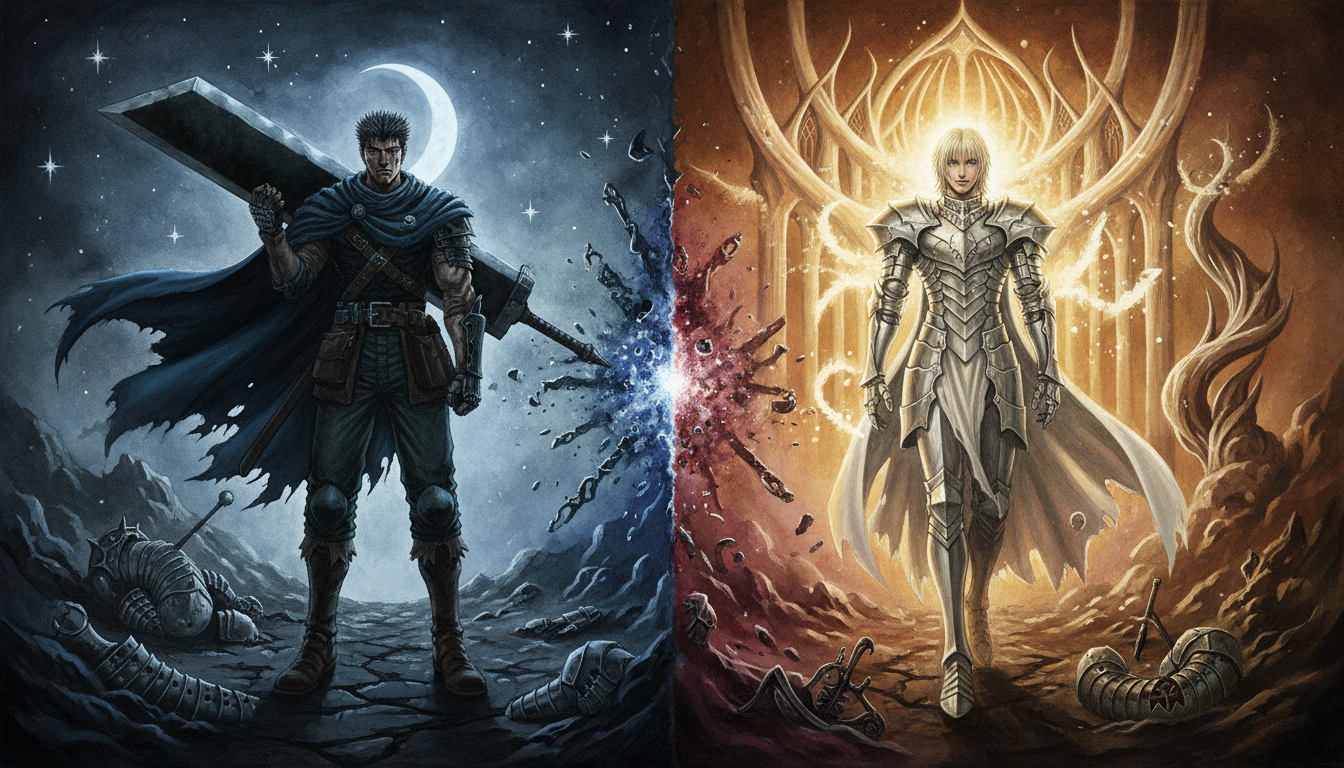
Berserk, the manga created by Kentaro Miura, is often remembered for its brutal violence and dark fantasy aesthetics.
However, beneath the bloodshed and monstrous imagery lies one of the most profound psychological explorations ever written in manga form.
At its core, Berserk is not a story about demons.
It is a story about trauma, survival, identity, and the human struggle to find meaning in a world defined by suffering.
Miura uses violence not as spectacle, but as a psychological language.
Every scar, every battle, and every loss reflects the internal state of its characters.
Guts: Trauma, Rage, and Survival Instinct
Guts, the protagonist of Berserk, is the embodiment of extreme psychological trauma.
Born from a corpse on a battlefield, his life begins in death and violence.
From the very start, Guts is denied safety, stability, and unconditional love.
His childhood is marked by abandonment, physical abuse, sexual trauma, and betrayal.
These experiences shape his core psychological traits: hypervigilance, emotional detachment, and explosive rage.
Guts does not fight because he enjoys violence.
He fights because survival is the only language he has ever learned.
His anger functions as a defense mechanism.
By focusing his pain outward, Guts avoids confronting the vulnerability and grief that lie beneath.
This is why moments of stillness are often more terrifying for him than battle.
Silence forces him to face emotions he has spent his entire life suppressing.
The Brand of Sacrifice: Living with Constant Threat
The Brand of Sacrifice is one of the most powerful psychological symbols in Berserk.
It represents chronic trauma — the idea that danger never truly ends.
Even in moments of peace, Guts is hunted, mirroring how trauma survivors often feel perpetually unsafe.
Sleep, rest, and intimacy become difficult or impossible.
The nervous system remains locked in a permanent fight-or-flight state.
Miura portrays this condition with brutal honesty.
Guts’ exhaustion is not just physical; it is psychological burnout.
The Brand also isolates him from others.
Getting close to people means putting them in danger, reinforcing his belief that solitude is safer than connection.
Griffith: Narcissism, Idealization, and the Fear of Powerlessness
Griffith is not simply a villain.
He is a psychological study of narcissism, ambition, and fragile identity.
At first glance, Griffith appears charismatic, confident, and visionary.
But his sense of self is entirely dependent on control and admiration.
His dream is not just a goal — it is his identity.
Without it, he ceases to know who he is.
When Griffith experiences helplessness and loss of agency, his psychological structure collapses.
The Eclipse represents a breaking point where narcissistic entitlement overrides empathy.
Griffith’s transformation into Femto symbolizes emotional dissociation taken to its extreme.
He sacrifices his humanity to escape vulnerability.
Rather than confront pain, he transcends it by abandoning moral responsibility altogether.
Casca: Trauma, Regression, and Fragmented Identity
Casca’s psychological journey is one of the most tragic and realistic portrayals of trauma in manga.
After the Eclipse, her mind fractures under the weight of overwhelming abuse and loss.
Her regression is not weakness — it is a survival response.
Casca’s childlike state reflects dissociation, a common reaction to extreme psychological shock.
Her memories remain, but her conscious mind cannot safely process them.
Miura treats this condition with sensitivity.
Recovery is slow, nonlinear, and fragile.
Casca’s eventual healing arc emphasizes an essential truth about trauma:
there is no shortcut to recovery, and strength does not mean forgetting.
Violence as Psychological Expression
In Berserk, violence is never meaningless.
Every battle externalizes an internal struggle:
- Guts fights monsters because he sees himself as one.
- Griffith seeks domination to escape insignificance.
- Apostles embody twisted desires taken to their logical extreme.
Miura suggests that unchecked pain inevitably transforms into cruelty.
When suffering is ignored, it mutates.
This is why Berserk is so emotionally heavy.
It refuses to romanticize trauma or redemption.
Companionship, Healing, and the Fragility of Hope
Despite its darkness, Berserk is not nihilistic.
The introduction of Guts’ companions represents the slow re-emergence of trust.
Healing begins not through strength, but through vulnerability.
Guts’ greatest challenge is not defeating enemies.
It is allowing himself to be human again.
Miura argues that meaning is not found in grand dreams or destiny, but in shared suffering and mutual support.
Hope in Berserk is fragile, imperfect, and constantly threatened —
but it exists.
Conclusion: Berserk as a Psychological Masterpiece
Berserk is ultimately a meditation on pain and perseverance.
Guts represents survival through rage.
Griffith represents escape through domination.
Casca represents survival through fragmentation.
Together, they form a brutal yet deeply human psychological triad.
Miura does not offer easy answers.
Instead, Berserk asks a haunting question:
How much suffering can a human endure without losing their soul?