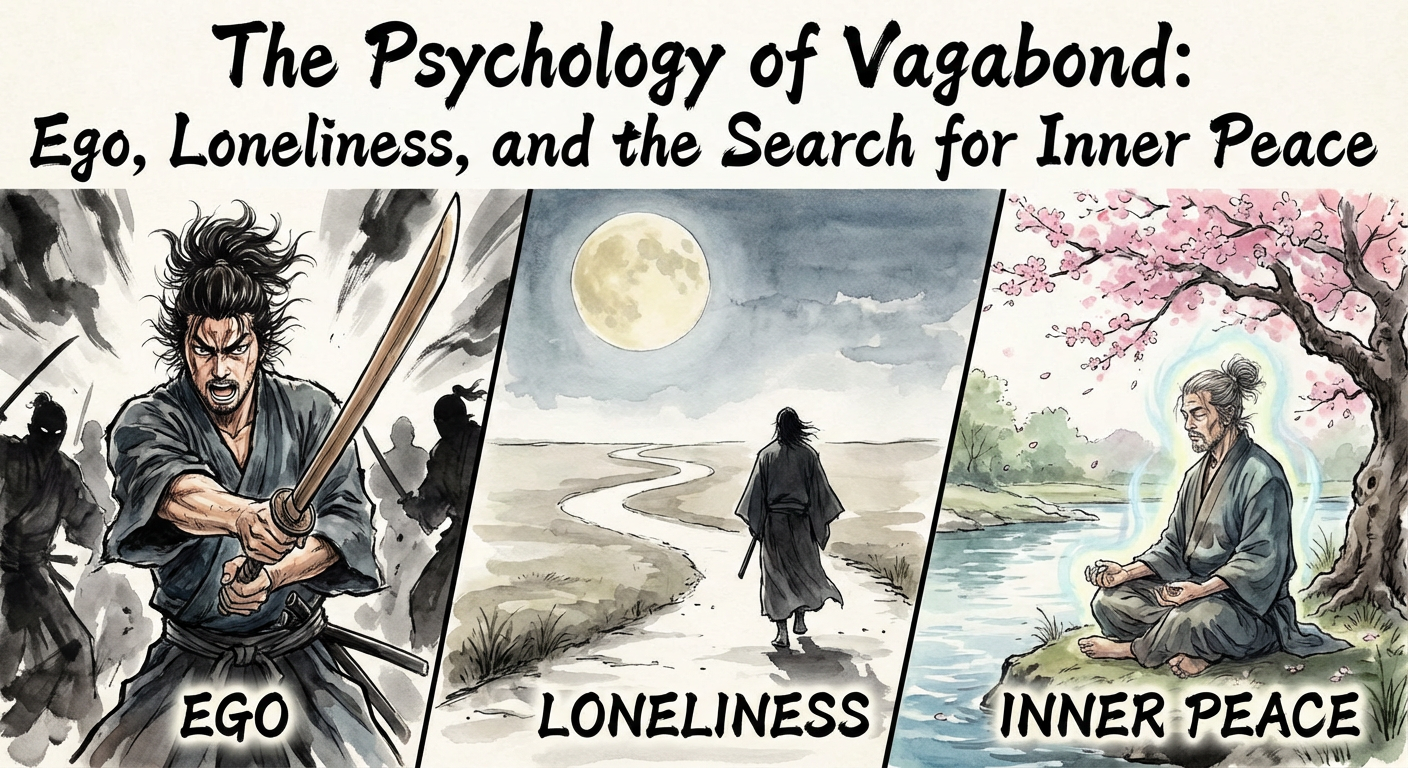
Vagabond, the manga created by Takehiko Inoue and inspired by the life of Miyamoto Musashi, is far more than a historical tale about samurai and swordsmanship.
At its core, Vagabond is a profound psychological journey that explores ego, identity, violence, and the long path toward inner peace.
Unlike traditional battle-driven narratives, Vagabond focuses on introspection.
Every duel reflects an internal conflict rather than a simple test of strength.
The sword becomes a tool for self-examination, not glory.
Inoue presents combat as a mirror of the soul, revealing the emotional and psychological state of each character.
Miyamoto Musashi: Ego, Rage, and the Desire to Be Invincible
Musashi begins his journey driven by a single obsession: becoming “invincible under the sun.”
This desire is rooted in fear.
Fear of weakness.
Fear of insignificance.
Fear of being forgotten.
Musashi equates strength with worth.
Winning battles becomes the only way he knows how to validate his existence.
Psychologically, this reflects an ego-driven identity.
Musashi defines himself entirely through external comparison, measuring his value against others.
His aggression functions as a defense mechanism.
By dominating opponents, he avoids confronting his own vulnerability.
Yet each victory leaves him emptier than before.
The stronger he becomes, the lonelier he feels.
Violence as a Stage of Psychological Immaturity
In Vagabond, violence is not glorified.
Early Musashi believes killing proves strength.
However, as his journey progresses, he begins to recognize the emotional cost of this belief.
Every life he takes leaves a psychological scar.
Inoue emphasizes silence, stillness, and reflection after battle to highlight the weight of violence.
This evolution represents emotional maturation.
Musashi slowly realizes that true strength cannot be built on constant destruction.
The manga suggests that obsession with power is often a symptom of unresolved inner conflict.
Sasaki Kojiro: Freedom, Innocence, and Natural Talent
Sasaki Kojiro serves as a psychological contrast to Musashi.
Deaf and largely free from societal expectations, Kojiro experiences the world intuitively.
He fights not out of ego, but out of curiosity and joy.
Kojiro represents a form of psychological freedom.
His lack of verbal language removes internal narratives of comparison and self-judgment.
Where Musashi overthinks, Kojiro simply is.
This contrast raises an important question:
Is strength found through discipline and suffering, or through harmony with oneself?
Takezo to Musashi: Identity Reconstruction
One of Vagabond’s most important themes is identity reconstruction.
The transition from Takezo to Musashi is not just a name change.
It symbolizes the painful dismantling of an old self.
Musashi must confront shame, regret, and the consequences of his actions.
Growth comes not from denial, but from acceptance.
Psychologically, this reflects the process of ego death.
To evolve, Musashi must let go of who he thought he needed to be.
Loneliness and the Cost of the Path
The path of the sword is deeply isolating.
As Musashi grows stronger, his emotional distance from others increases.
Friendships fade.
Romantic possibilities remain unfulfilled.
Vagabond portrays loneliness as the price of obsession.
The more narrowly one defines success, the more one sacrifices human connection.
Inoue uses long silent panels to convey emotional isolation.
Words become unnecessary when solitude dominates the inner world.
Nature, Stillness, and Inner Peace
As the story progresses, nature becomes a recurring psychological motif.
Fields, trees, rain, and seasons reflect Musashi’s internal transformation.
Stillness replaces chaos.
Musashi begins to understand that strength is not constant motion, but balance.
Not domination, but awareness.
The sword shifts from a weapon to a discipline.
From an extension of ego to a tool of understanding.
Conclusion: Vagabond as a Meditation on the Self
Vagabond is ultimately a meditation on what it means to live fully.
Musashi represents ego and struggle.
Kojiro represents freedom and instinct.
Their parallel paths highlight different ways of engaging with existence.
Takehiko Inoue does not offer a final answer.
Instead, Vagabond asks a quiet but powerful question:
What does it truly mean to be strong?
FAQ – The Psychology of Vagabond: Ego, Loneliness, and the Search for Inner Peace
What is the psychological focus of Vagabond?
Vagabond explores the inner struggles of Musashi Miyamoto, focusing on themes like ego, loneliness, and the search for meaning. The series delves into how personal ambition and the desire for perfection shape human behavior and mental states.
How does Musashi’s ego affect his journey in Vagabond?
Musashi’s ego drives him to constantly seek strength and recognition. While this fuels his growth as a swordsman, it also isolates him emotionally, leading to internal conflict and challenges in forming meaningful relationships.
Why is loneliness a recurring theme in Vagabond?
Loneliness reflects Musashi’s detachment from society and his obsession with self-perfection. His isolation emphasizes the emotional cost of his path as a warrior and highlights the psychological struggle of balancing ambition with human connection.
What does Vagabond teach about the search for inner peace?
The series suggests that true inner peace comes not from external achievement or recognition, but from self-awareness and acceptance. Musashi’s journey demonstrates that understanding oneself is essential to finding balance and tranquility.
Is Vagabond relevant for understanding human psychology?
Yes, Vagabond provides a profound exploration of human psychology. Through Musashi’s struggles with ego, ambition, and solitude, the story offers insights into the complexities of personal growth, emotional resilience, and self-discovery.