General Information
Volumes: 18
Genre: Psychological Thriller, Mystery, Drama, Crime
Release Year: 1994–2001
Status: Completed
Rating: 9.3/10
Source Material: Original manga by Naoki Urasawa
Adaptations: Anime series (2004–2005)
Monster is a psychological thriller manga by Naoki Urasawa that explores the nature of evil, morality, and personal responsibility. Unlike traditional antagonists, Monster presents horror through realism and psychological tension rather than supernatural elements.
It is widely regarded as one of the most mature and intellectually demanding manga ever written.
Synopsis
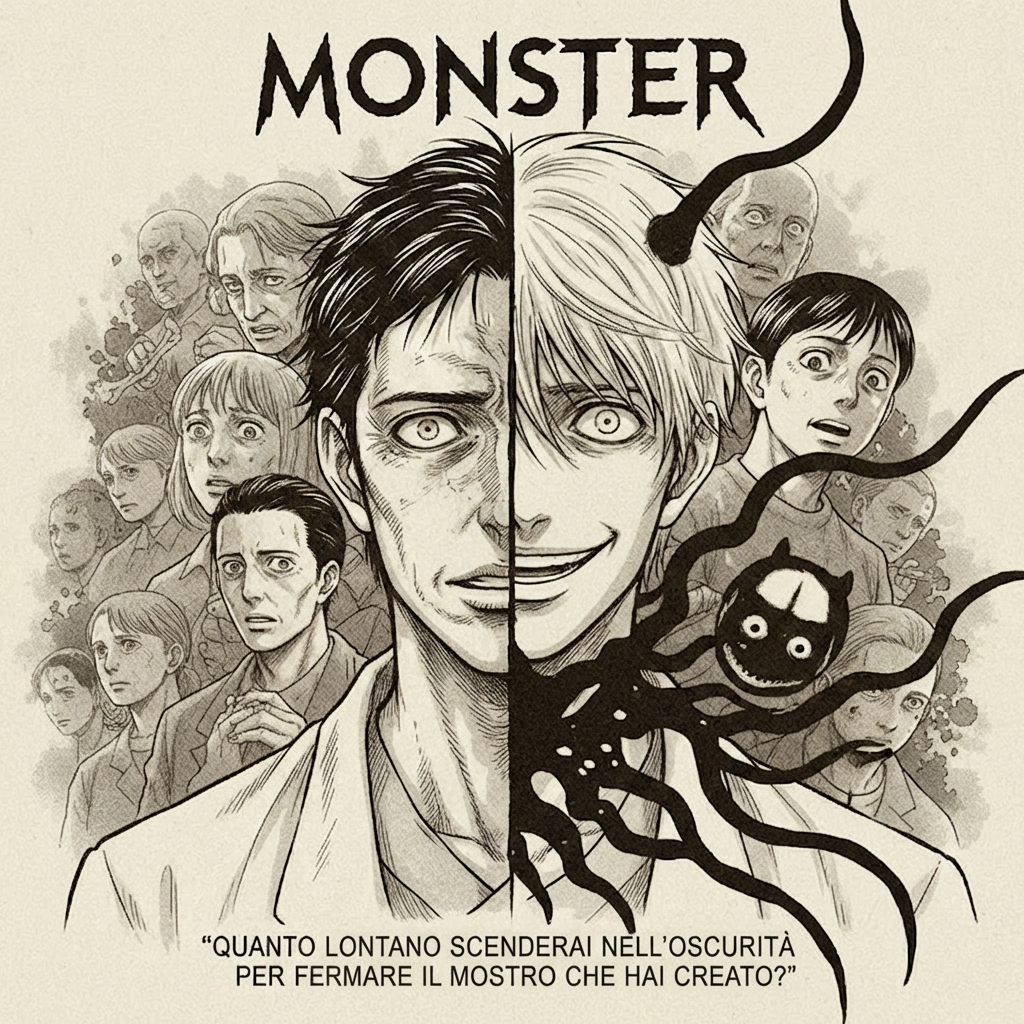
The story follows Dr. Kenzo Tenma, a brilliant neurosurgeon living in Germany. When forced to choose between saving a child or an influential politician, Tenma chooses the child, Johan Liebert.
Years later, Tenma discovers that Johan has grown into a charismatic and terrifying serial killer. Overcome with guilt, Tenma abandons his career to hunt Johan and prevent further deaths.
What follows is a chilling journey across Europe, where Tenma confronts not only Johan but the darkest aspects of human psychology.
Main Characters
Kenzo Tenma
Tenma is a deeply moral character driven by guilt and responsibility. His decision to save a life becomes the catalyst for immense suffering.
Psychologically, Tenma represents the burden of ethical choice. His journey questions whether good intentions absolve one from unintended consequences.
Johan Liebert
Johan is one of manga’s most unsettling villains. Calm, intelligent, and emotionally empty, he embodies pure nihilism.
Rather than acting out of rage, Johan manipulates others into committing atrocities. He represents the idea that evil can be quiet, charming, and disturbingly human.
Nina Fortner (Anna Liebert)
Johan’s twin sister and a survivor of childhood trauma. Nina’s arc explores memory repression, guilt, and the long shadow of abuse.
She represents the possibility of healing in contrast to Johan’s descent into darkness.
Themes and Analysis
At its core, Monster examines the nature of evil.
Urasawa refuses to present easy answers. Evil is not portrayed as supernatural, but as the result of neglect, trauma, ideology, and moral failure.
Another major theme is responsibility. The manga asks whether individuals are accountable for the outcomes of their ethical decisions, even when those outcomes are unforeseeable.
Monster also explores identity and nihilism, questioning whether a life without meaning inevitably leads to destruction.
Why You Should Read Monster
Monster is ideal for readers who appreciate slow-burn narratives and psychological complexity. It rewards patience with deep character studies and moral ambiguity.
Its realism makes it especially disturbing, as it reflects real human darkness rather than fictional monsters.
Final Verdict
Monster is a chilling exploration of morality, guilt, and the fragility of human goodness.
It challenges readers to confront uncomfortable truths about responsibility and the capacity for evil within ordinary people.
For fans of psychological storytelling, Monster is essential reading.
FAQ – Monster: The Horror of Human Nature
What is Monster about?
Monster is a psychological thriller anime that follows Dr. Kenzo Tenma, a Japanese brain surgeon in Germany, who becomes entangled in a deadly conspiracy after saving the life of a young boy, Johan Liebert. The series explores morality, justice, and the dark side of human nature.
Who is the main villain in Monster?
The main villain is Johan Liebert, a charismatic yet terrifying figure who manipulates and destroys lives. Johan embodies the concept of pure evil, demonstrating how human psychology can be twisted to terrifying extremes.
What are the main themes in Monster?
The anime explores themes such as morality, the nature of evil, the consequences of choices, identity, and the psychological complexity of humans. It raises questions about what makes someone truly monstrous—nature, nurture, or personal decisions.
Why is Monster considered psychologically intense?
Monster is psychologically intense because it focuses on character development, moral dilemmas, and suspense rather than action. The series portrays the inner struggles of both the protagonist and antagonist, highlighting the fragility of human ethics.
Is Monster worth watching?
Yes, Monster is highly recommended for fans of psychological thrillers and deep character studies. Its slow-burn storytelling, intricate plot, and exploration of human evil make it a classic that resonates even decades after release.