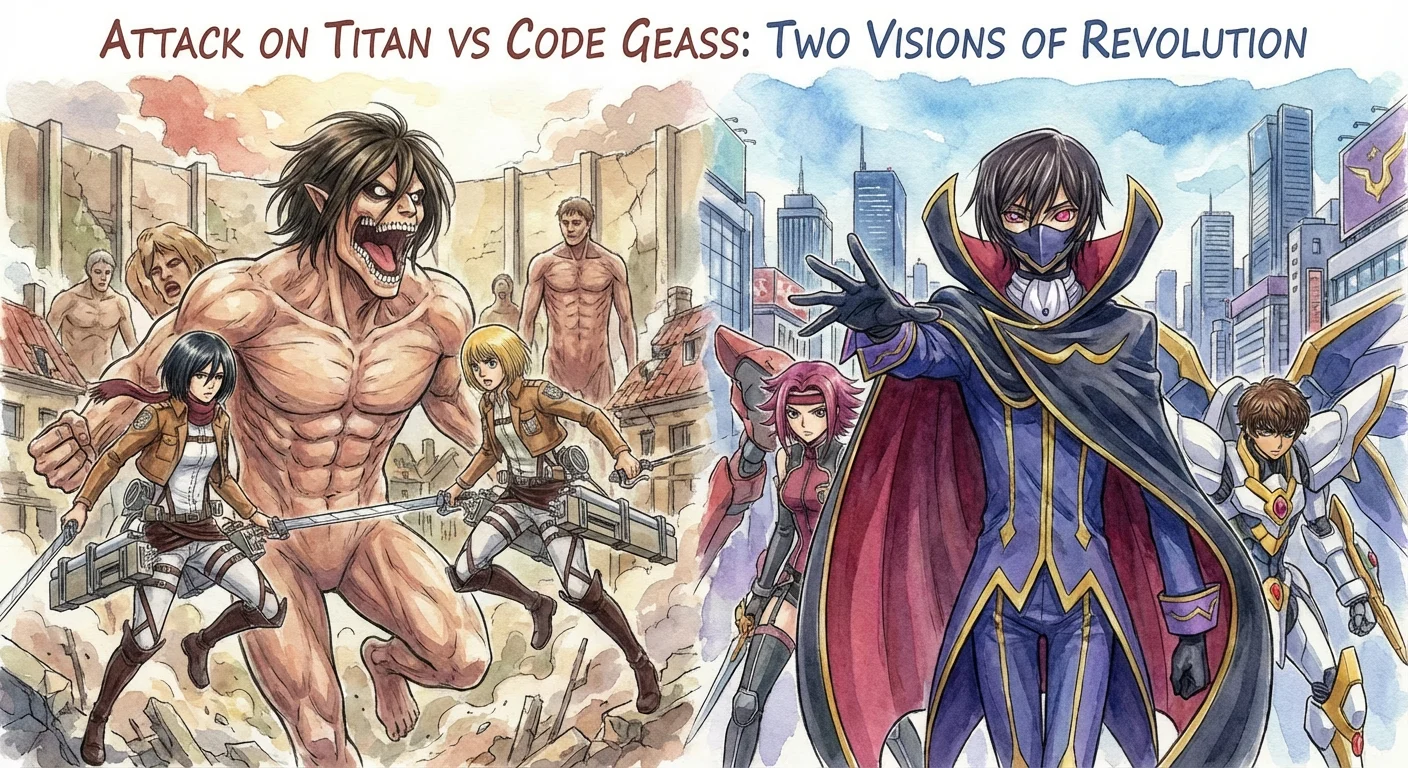
Revolution is one of the most powerful themes in anime storytelling. Few series explore it as deeply and differently as Attack on Titan and Code Geass.
At first glance, these two anime may seem similar. Both feature oppressed societies, war, and protagonists willing to challenge the world order. However, when you look closer, their visions of revolution could not be more different.
One is chaotic, brutal and morally ambiguous.
The other is strategic, calculated and theatrical.
This contrast is what makes comparing them so fascinating.
Two Protagonists, Two Revolutions
At the center of these stories are two unforgettable characters: Eren Yeager and Lelouch Lamperouge.
Eren begins his journey driven by anger and a desire for freedom. His world is cruel and unforgiving, and his revolution grows out of pain, trauma and survival.
Lelouch, on the other hand, is a strategist from the very beginning. His rebellion is not fueled by raw emotion alone, but by a calculated plan to destroy an empire and reshape the world.
While both characters seek change, their methods and motivations define two completely different approaches to revolution.
Chaos vs Strategy
In Attack on Titan, revolution feels unpredictable and destructive.
Eren’s actions often escalate conflict rather than resolve it. The story reflects a world where violence creates more violence, and where no solution comes without devastating consequences.
There is no clear plan, no perfect outcome—only a constant cycle of war and retaliation.
In contrast, Code Geass presents revolution as a game of strategy.
Lelouch carefully manipulates people, events and entire systems. Every move is part of a larger plan. His rebellion is structured, controlled and often theatrical, turning war into a psychological and political chess match.
Freedom vs Control
One of the biggest differences between the two series lies in their core themes.
In Attack on Titan, the driving force is freedom.
Eren’s entire journey revolves around the desire to break free—from walls, from enemies, from destiny itself. However, the story constantly questions whether true freedom is even possible.
In Code Geass, the focus shifts toward control.
Lelouch seeks to control the system, to dismantle it from within and rebuild it according to his vision. His revolution is not about escaping the world, but about reshaping it.
The Cost of Revolution
Both anime explore the consequences of rebellion, but in very different ways.
In Attack on Titan, the cost is overwhelming and often senseless. Innocent lives are lost, moral lines are blurred and the idea of “right” and “wrong” becomes increasingly unclear.
The series suggests that revolution may not lead to salvation, but to further suffering.
In Code Geass, the cost is more intentional.
Lelouch is fully aware that his actions will require sacrifice. He accepts the burden of becoming a villain in order to achieve a greater goal.
This difference creates a powerful contrast:
Eren is consumed by his revolution, while Lelouch controls his.
Ideology and Moral Ambiguity
Neither series offers a simple moral answer.
Eren’s actions force the audience to question whether extreme violence can ever be justified in the name of freedom.
Lelouch’s choices raise a different question:
Is it acceptable to manipulate and sacrifice others if the end result is peace?
Both characters operate in morally gray areas, but their philosophies lead them in very different directions.
Which Vision of Revolution Is More Effective?
This is where the comparison becomes truly interesting.
Attack on Titan presents a realistic and pessimistic view of revolution. It reflects the chaos of real-world conflicts, where outcomes are uncertain and consequences are devastating.
Code Geass offers a more idealized and strategic vision, where a single individual can reshape the world through intelligence, planning and sacrifice.
Neither approach is inherently better. Instead, they highlight two sides of the same concept:
- revolution as uncontrollable force
- revolution as calculated transformation
Final Thoughts
The revolutions led by Eren Yeager and Lelouch Lamperouge are not just conflicts within their stories.
They are reflections of two fundamentally different ways of seeing the world.
One is driven by emotion, chaos and the desperate search for freedom.
The other by strategy, control and the willingness to sacrifice everything for a greater goal.
In the end, both stories ask the same question:
Can you truly change the world without becoming a part of its darkness?