General Information
Title: Asadora!
Japanese Title: あさドラ!
Author: Naoki Urasawa
Genres: Seinen, Drama, Mystery, Historical Fiction, Science Fiction, Kaiju
Publisher: Shogakukan
Magazine: Weekly Big Comic Spirits
Original Release: 2018–present
Japanese Volumes: 10
English Volumes: 9 published
European Volumes: Varies by country; 9 published in Italy, France, and Germany
Chapters: 65+; ongoing
Status: Ongoing
Anime Adaptation: None announced
Introduction
What happens when a seemingly ordinary girl becomes involved in a mystery that could change the fate of an entire country?
That is the central question behind Asadora!, the ambitious manga written and illustrated by Naoki Urasawa, the acclaimed creator of Monster, 20th Century Boys, and Pluto.
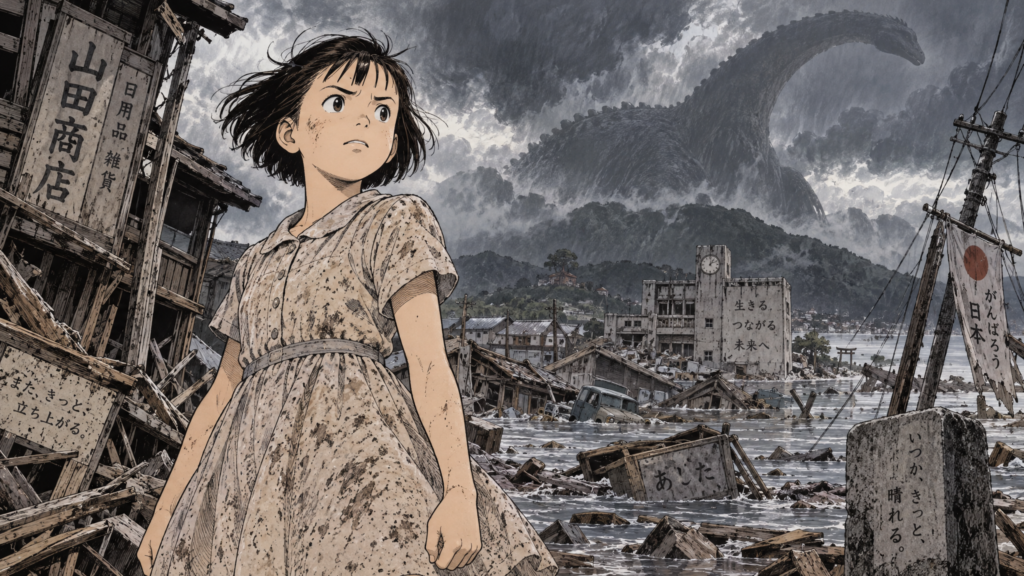
First published in 2018, Asadora! combines historical drama, mystery, adventure, and giant-monster fiction. Its story follows Asa Asada, a spirited girl growing up in postwar Japan whose life takes an extraordinary turn during a devastating typhoon.
At first, the manga appears to be a coming-of-age story about a young girl trying to find her place in the world. Gradually, however, Urasawa introduces a much larger mystery involving a mysterious creature, political intrigue, and events spanning several decades.
The result is a story that moves between intimate human drama and spectacular disaster.
Unlike many manga that focus on a single genre, Asadora! constantly changes perspective. It explores family relationships, social change, ambition, friendship, and the consequences of historical events while keeping an enormous question hanging over the entire narrative.
For fans of Urasawa’s intricate storytelling, this combination makes Asadora! a particularly fascinating read.
What Is Asadora! About?
The story begins in 1959 in Nagoya, Japan.
Asa Asada is a young girl from a large family. Energetic, determined, and frequently overlooked by those around her, she is accustomed to having to fight for attention.
When her mother goes into labor, Asa runs out to find a doctor.
However, nobody seems particularly concerned when she fails to return home.
As a typhoon approaches, Asa encounters a burglar who initially becomes her kidnapper. Their situation changes dramatically when the storm strikes and the two must cooperate to survive.
This unexpected encounter becomes the beginning of Asa’s extraordinary journey.
The typhoon exposes her to a world far larger than the one she has known. As the story progresses, she becomes connected to people whose lives are shaped by historical events, personal ambitions, and mysterious forces.
The narrative then moves across different periods, eventually connecting Asa’s experiences to a terrifying event in 2020, when a gigantic creature attacks Tokyo.
The central mystery is simple to describe but difficult to unravel:
What connects a young girl living in postwar Japan to a monster threatening the modern world?
Urasawa gradually reveals the answers, building a narrative that becomes more complex with every major development.
Asa Asada: A Remarkable Protagonist
Asa is the heart of Asadora!.
She is not a conventional action hero, nor does she begin the story with extraordinary powers or special knowledge.
Instead, her greatest qualities are her determination, courage, and willingness to act when others hesitate.
Asa often finds herself in situations that would overwhelm someone much older. Nevertheless, she refuses to remain passive.
Her personality makes her immediately engaging. She can be impulsive, stubborn, and occasionally reckless, but these characteristics also allow her to accomplish things that more cautious characters would never attempt.
What makes Asa especially interesting is the way she grows alongside the world around her.
Her personal development takes place against the backdrop of Japan’s transformation from a society recovering from war into a modern economic and technological power.
Through Asa, readers experience these changes on a personal level rather than simply observing them as historical events.
She is a compelling protagonist because her story remains grounded in human emotions, even when the narrative expands into extraordinary territory.
A Story That Spans Generations
One of the defining characteristics of Asadora! is its broad historical scope.
The story begins in 1959 and eventually connects its characters and mysteries to events in 2020.
This allows Urasawa to explore several decades of Japanese history, including the country’s economic development, changing social expectations, and evolving relationship with technology.
The passage of time also gives the characters opportunities to grow, change, and reconsider their earlier decisions.
People who initially appear to be supporting characters can become important to the larger narrative. Events that seem insignificant in one period may acquire entirely different meanings years later.
This structure is familiar to readers of 20th Century Boys, where personal memories and historical developments gradually combine into a larger mystery.
However, Asadora! has its own identity. Its central character and more adventurous tone give the story a different emotional texture.
The Mystery of the Giant Monster
Although Asadora! begins as a historical drama, its giant-monster storyline gradually becomes one of its most intriguing elements.
In 2020, a gigantic creature appears and threatens Tokyo.
The creature’s existence immediately raises several questions.
Where did it come from?
Why has it appeared?
What is its connection to the events of 1959?
And why does Asa appear to be connected to a mystery that began decades earlier?
Urasawa deliberately avoids explaining everything immediately. Instead, he reveals information through investigations, character interactions, and unexpected discoveries.
This slow revelation is one of the manga’s greatest strengths.
The monster is not simply an excuse for spectacular destruction. Its existence creates a mystery that connects the different periods of the story.
The reader is encouraged to look for patterns, reconsider earlier scenes, and question whether seemingly unrelated events might share a common cause.
More Than a Kaiju Manga
Readers approaching Asadora! expecting a traditional giant-monster story may be surprised by its structure.
Although the kaiju elements are important, the manga spends considerable time developing its characters and exploring their everyday lives.
There are personal struggles, professional ambitions, family conflicts, friendships, and political complications.
The monster is only one part of a much larger narrative.
This balance distinguishes Asadora! from stories in which giant creatures exist primarily to provide action and destruction.
Urasawa is more interested in the way extraordinary events affect ordinary people.
How do individuals respond when the world becomes unpredictable?
What happens when personal responsibilities collide with a national emergency?
And how do governments, organizations, and ordinary citizens react when confronted with something they cannot easily understand?
These questions give the science-fiction elements greater weight.
Postwar Japan and Historical Change
The historical setting is essential to understanding Asadora!.
The story begins during a period when Japan was still dealing with the consequences of World War II while rapidly transforming its economy and society.
Urasawa uses this background to create a world that feels alive.
Cities change. New technologies become available. Social expectations evolve. Characters who grow up in one historical period must adapt to circumstances that would have seemed unimaginable during their childhoods.
These changes also influence the way characters understand their place in society.
Asa’s experiences are shaped by the expectations placed on girls and women, the limitations of her family circumstances, and the opportunities that gradually become available to her.
The historical setting is therefore more than a backdrop. It actively shapes the story and the choices available to its characters.
Family, Loneliness, and Belonging
Despite its large-scale mystery, Asadora! remains deeply interested in personal relationships.
Asa grows up in a family where she often struggles to receive the attention she wants.
This early experience helps explain her independent nature and her determination to prove herself.
Her relationships with other characters gradually provide her with a sense of belonging beyond her immediate family.
These connections are important because they prevent Asa from becoming merely a vehicle for the plot.
She has emotional needs, personal ambitions, and vulnerabilities that exist independently of the monster mystery.
Urasawa understands that readers become invested in an extraordinary story when they care about the people caught inside it.
The more Asa’s world expands, the more important these human connections become.
The Meaning of Heroism
Another recurring theme in Asadora! is the idea that heroism does not necessarily involve extraordinary strength.
Asa is brave, but she is also vulnerable.
She makes mistakes, experiences fear, and sometimes acts before fully understanding the consequences.
Her courage comes from her willingness to keep moving forward despite these limitations.
This makes her a different kind of hero from the powerful protagonists commonly found in action manga.
Asa’s story suggests that heroism can emerge from ordinary people who choose to act when circumstances demand it.
The theme becomes particularly significant as the stakes grow larger and her decisions begin to affect people far beyond her immediate circle.
Naoki Urasawa’s Storytelling
Urasawa’s narrative technique is one of the main reasons to read Asadora!.
His stories frequently begin with seemingly disconnected events, characters, and mysteries. Over time, these elements begin to converge, revealing connections that were not immediately apparent.
Asadora! follows this approach.
The opening chapters establish Asa’s personality and circumstances, but they also introduce questions that will remain relevant much later in the story.
Urasawa is particularly skilled at creating anticipation without revealing too much.
A conversation can introduce an important clue. A minor character can return with unexpected significance. A seemingly unrelated historical event can become central to the mystery.
This structure rewards attentive readers and encourages discussion between chapters.
It also means that the manga benefits from being read with patience. Some of its most satisfying moments depend on information established much earlier.
The Artwork
Urasawa’s artwork is another major strength.
His characters are expressive without relying on exaggerated facial reactions. Their emotions often emerge through subtle changes in posture, expression, and body language.
This approach works particularly well in a story that combines intimate drama with large-scale spectacle.
Everyday scenes feel believable, while the larger action sequences have a strong sense of scale.
The environments also receive considerable attention. Urasawa depicts streets, buildings, vehicles, and historical settings with enough detail to make the world feel tangible.
When the giant creature appears, its size becomes especially striking because it exists within an otherwise recognizable environment.
The contrast between ordinary life and extraordinary danger helps make the monster feel genuinely threatening.
Asadora! Compared to Monster and 20th Century Boys
Readers familiar with Urasawa’s earlier works will recognize several recurring characteristics.
| Element | Asadora! | Monster | 20th Century Boys |
|---|---|---|---|
| Main genre | Historical drama, mystery, science fiction | Psychological thriller | Mystery, science fiction, thriller |
| Central focus | Asa and the giant-monster mystery | Tenma’s pursuit of Johan | A conspiracy connected to childhood memories |
| Narrative scope | Multiple decades | International investigation | Multiple periods and generations |
| Atmosphere | Adventurous and suspenseful | Dark and tense | Nostalgic and apocalyptic |
| Main appeal | Character growth and kaiju mystery | Psychological complexity | Conspiracy and interconnected mysteries |
Although the three manga share Urasawa’s interest in complex plotting, they offer different experiences.
Monster is a psychological thriller driven by moral questions and the pursuit of a dangerous individual.
20th Century Boys focuses on conspiracy, memory, friendship, and an increasingly large-scale threat.
Asadora! combines elements of both approaches with a coming-of-age story and giant-monster fiction.
For readers who enjoy Urasawa’s ability to connect individual lives with much larger events, it is a natural addition to their reading list.
Is Asadora! Difficult to Follow?
The manga contains several timelines, a large cast of characters, and mysteries that unfold gradually.
Readers who prefer straightforward narratives may occasionally find it challenging to keep track of every connection.
However, Urasawa provides enough character development and narrative clues to make the story rewarding.
The important thing is not to expect every question to be answered immediately.
Some developments only become meaningful after several chapters, and the story deliberately maintains a degree of uncertainty.
Readers who enjoy theories, foreshadowing, and gradually unfolding mysteries are likely to appreciate this approach.
Why You Should Read Asadora!
1. A Unique Blend of Genres
The manga combines historical fiction, coming-of-age drama, mystery, and kaiju storytelling without allowing any single element to overwhelm the others.
2. A Memorable Female Protagonist
Asa is energetic, determined, and imperfect. Her personal growth provides the emotional foundation for the larger story.
3. An Intriguing Mystery
The relationship between the events of 1959 and the giant-monster attack in 2020 creates a compelling reason to keep reading.
4. Rich Historical Detail
The changing landscape of postwar Japan adds depth to the narrative and influences the lives of its characters.
5. Urasawa’s Narrative Skill
The gradual connections between characters, events, and timelines reward attentive readers.
6. Excellent Artwork
Expressive characters, detailed environments, and cinematic compositions make the manga visually engaging.
Is Asadora! Worth Reading?
Yes. Asadora! is particularly appealing to readers who enjoy manga that combine character development with large-scale mysteries.
If you loved Monster or 20th Century Boys, you will probably recognize Urasawa’s talent for constructing stories in which apparently unrelated events gradually come together.
However, Asadora! is not simply another psychological thriller.
Its protagonist is younger, its historical setting is central to the story, and its giant-monster elements introduce a more adventurous form of science fiction.
Readers looking for constant battles may find the pacing too deliberate. Much of the manga’s appeal comes from its characters, historical context, and unanswered questions.
Those willing to invest in a long-running mystery will find plenty to enjoy.
Final Verdict
Asadora! is one of Naoki Urasawa’s most intriguing later works, combining a coming-of-age story with historical drama, mystery, and giant-monster fiction.
Its greatest strength lies in the contrast between its personal and spectacular elements.
On one level, it is the story of Asa Asada, a determined girl growing up in a changing Japan. On another, it is a mystery connecting decades of history to a creature capable of threatening an entire city.
Urasawa brings these elements together through expressive artwork, memorable characters, and carefully structured storytelling.
Although the ongoing publication means that some questions remain unanswered, this is also part of the experience. Each new development has the potential to change how readers understand earlier events.
For fans of Naoki Urasawa, historical manga, complex mysteries, and kaiju stories, Asadora! is well worth reading.
FAQ
What is Asadora! about?
Asadora! follows Asa Asada, a young girl growing up in postwar Japan whose life becomes connected to a mysterious giant creature that attacks Tokyo decades later.
Who created Asadora!?
The manga was written and illustrated by Naoki Urasawa, the creator of Monster, 20th Century Boys, and Pluto.
How many volumes of Asadora! are there?
As of October 2026, 10 volumes have been released in Japan. The English edition has reached Volume 9, as has the Italian edition published by Planet Manga. <Cite refs={[“turn786111search11″,”turn786111search3″,”turn160611search0”]}/>
How many chapters does Asadora! have?
Asadora! is ongoing, and the exact chapter total depends on the latest releases and the database consulted. The manga’s collected volumes provide a reliable way to follow its publication progress.
Is Asadora! finished?
No. As of October 2026, the manga remains ongoing.
Is Asadora! a kaiju manga?
Partly. The giant creature is central to the overarching mystery, but the manga also focuses on historical drama, Asa’s personal development, and the relationships between its characters.
Is Asadora! similar to Monster?
Both works share Naoki Urasawa’s interest in complex plotting and interconnected mysteries. However, Asadora! is more focused on historical change, coming-of-age drama, and giant-monster science fiction.
Does Asadora! have an anime adaptation?
No anime adaptation has been officially announced as of October 2026.